dotdailydose
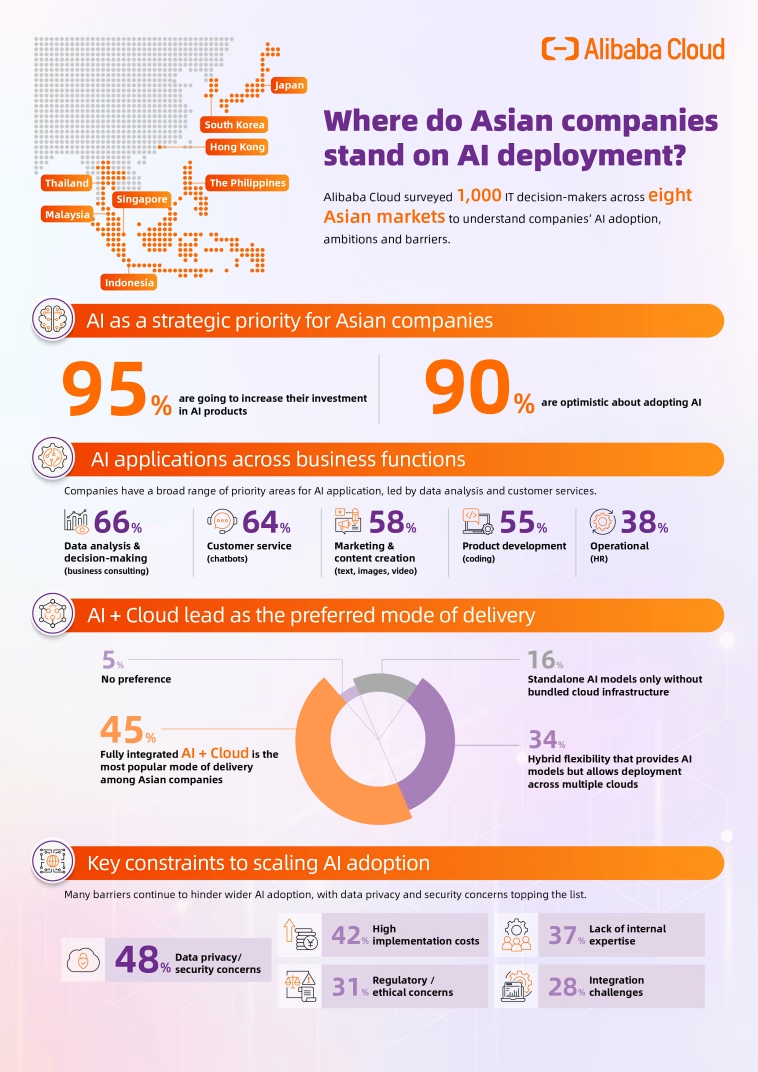
A survey report entitled “The AI Business Application Readiness and Accessibility Survey” commissioned by Alibaba Cloud, a leading global provider of AI infrastructure and the intelligence backbone of Alibaba Group, reveals near‑universal enthusiasm for AI among Asian enterprises. Among respondents, 90% describe their organization as optimistic about adopting AI.
Philippine enterprises are among the region’s AI optimists: 91% hold a positive attitude toward AI adoption, including 57% who are “very positive,” actively exploring or implementing AI. This ambition rests on a solid cloud foundation, with 74% having migrated all or most of their IT infrastructure to the cloud. Reflecting a growth-first mentality, local businesses treat AI as a growth engine rather than a cost-cutting tool: driving innovation and new business opportunities (68%) leads their strategic objectives — ahead of cost savings and efficiency (54%), customer experience improvement (51%), competitive advantage (50%) and revenue growth potential (39%). Data privacy and security is the top local barrier to broader adoption (51%), ahead of high implementation costs (41%).

Dr. Feifei Li, Chief Technology Officer and President of International Business, Alibaba Cloud Intelligence Group, said: “The research findings reinforce Alibaba Cloud’s belief that AI, delivered on top of scalable, secure cloud infrastructure and models, will be the defining technology platform for the next decade. As we enter the agentic AI era, our focus is shifting from producing efficient tokens to enabling actionable outcomes. By building a comprehensive agentic cloud, we provide the critical infrastructure — such as runtime sandboxes and orchestration — that empowers enterprises to build the agent-native products of tomorrow seamlessly.”
This sentiment is translating into concrete spending plans: 95% of surveyed companies intend to increase investment in AI products, with more than half planning to raise budgets by over 20% across infrastructure (IaaS), platform tools (PaaS) and model services (MaaS). As AI continues to be the focus of conversations within and beyond boardrooms, 58% have indicated plans for more than 20% growth in MaaS spending, a relatively new concept compared to the highest planned investment in foundational infrastructure, such as compute, storage and networking, with 69% indicating more than 20% growth in IaaS spending, followed by 61% planning similar growth in PaaS spending.
Top Five Strategic Objectives of AI Adoption
AI is already moving from the pilot stage to production for a significant share of respondents. Around 75% Asian companies say AI has become indispensable to their business operations. Across the stack, approximately 90% of companies report they have started adopting AI development tools (PaaS) and models (MaaS). Notably, only 1% of all respondents say AI is not a priority.
Moving beyond simply achieving cost savings and efficiency (63%), the top strategic objectives reported for AI adoption include driving innovation and new business opportunities (64%), followed by unlocking revenue growth potential (48%). Gaining competitive advantage (45%) and improving customer experience (43%) are also among the top five objectives.
Functionally, enterprises are prioritizing data analysis and decision‑making (66%), customer service tools such as chatbots (64%), marketing and content creation (58%), product development including coding (55%), and HR operations (38%).
The Need for A Full-Stack Agentic Cloud
The study underscores strong demand for integrated AI and Cloud solutions delivered via a single, coherent stack. When selecting AI solution providers, 45% of respondents prefer fully integrated AI + Cloud offerings, compared with 34% who favor hybrid flexibility with models deployable across multiple clouds, and only 16% who prefer standalone AI models without bundled cloud infrastructure.
Integrated AI + Cloud architectures often appeal because they centralize management and security for data and models, simplify deployment, and give enterprises clearer control over cost via pay‑as‑you‑go models. Respondents highlight that integrated stacks help them standardize data pipelines, apply consistent governance and security policies, and accelerate time‑to‑value for AI initiatives.
Barriers: Privacy, Cost and Skills Gaps
Despite strong enthusiasm and investment, organizations face material barriers to scaling AI. Respondents rate data privacy and security concerns as the top challenge, cited by 48% as a leading obstacle to broader adoption. High implementation costs followed (42%), while 37% point to a lack of internal expertise as a major constraint.
Regulatory and ethical concerns are another significant friction point, mentioned by 31% of respondents overall, with this figure rising sharply in more regulated sectors such as financial services, education, and the public sector. Additional barriers include integration challenges (28%), the limited accessibility of suitable solutions (23%), an unclear return on investment (22%), a lack of obvious business cases (19%) and resistance from management‑level executives (18%).
Demand for Sector‑Specific, End‑to‑End Solutions

Across industries, respondents report high levels of accessibility to individual AI products — on average, 91% say AI solutions are available in their markets. However, they identify a gap when it comes to comprehensive, end‑to‑end solutions that address sector‑specific scenarios and integrate seamlessly into existing systems and workflows.
The research found that support needs cluster around three themes: more customized AI solutions tailored to industry use cases (54%), better availability of talent and skills (49%), and more accessible, affordable offerings (45%). Enterprises also call for successful case studies (42%), vendor‑provided training (41%) and stronger board and management endorsement (32%) to unlock large‑scale deployments and secure internal sponsorship.
“The pace of AI adoption in the Philippines is driven by two factors: large enterprises are pursuing AI initiatives as part of their top-level strategic digital transformation, while small and medium-sized enterprises (SMEs) are adopting software to meet their operational needs for cost reduction and efficiency improvement,” said Grant Gong, Head of Solutions Architect, Alibaba Cloud Philippines.
Gong also noted that Philippine businesses in financial and retail sectors showed particularly strong enthusiasm about adopting AI.
Importance of Local Language Support
Language also emerges as a critical success factor for AI accessibility. In markets such as Japan, South Korea, Indonesia and Thailand, enterprises report that the scarcity of high‑quality local‑language models is holding back development, even as English‑ and Chinese‑language models proliferate.
Survey data show that only around half of respondents select English as their primary language for AI solutions, with the rest choosing Bahasa, Japanese, Korean, Thai and other local languages. Products that natively support multiple Asian languages are therefore winning market share, with Alibaba Cloud’s Qwen models cited as especially popular in Japan and South Korea due to their strong performance in local languages and support for over 200 languages and dialects in Qwen’s latest generation.
Alibaba Cloud’s Role as Full‑Stack AI Partner
The report positions these findings within Alibaba Cloud’s broader AI + Cloud strategy and investment roadmap. Alibaba Group has announced plans to invest at least RMB380 billion (approximately USD53 billion) over three years to expand cloud computing and AI infrastructure, an amount that exceeds its AI and cloud spending over the previous decade. The company offers full‑stack capabilities from foundational infrastructure to platforms and self‑developed models, including the Qwen language family and Wan image and video generation models.
Implications for Global Business Leaders
For international enterprises evaluating AI strategies in Asia and beyond, the study offers three key signals.
- AI demand is moving quickly from curiosity to commitment, with budgets, roadmaps and early production use cases already in place across a wide range of industries.
- Successful adoption will depend on trusted, integrated AI + Cloud partners that can deliver secure, sector‑specific, end‑to‑end solutions while helping clients navigate privacy, regulatory and talent challenges.
- Open, multi-lingual ecosystems — combining strong local language support with robust governance, tools and training — will be critical to unlocking AI’s full value for a range of workforces and customer bases.
About the Report
Alibaba Cloud commissioned independent research firm NielsenIQ (NIQ) to survey 1,000 IT decision makers evenly distributed across eight markets — Hong Kong, Indonesia, Japan, Malaysia, the Philippines, Singapore, South Korea and Thailand in mid‑2025. Respondents span internet and technology, manufacturing, professional and financial services, retail, public sector and other industries, with the majority drawn from manager- and director-level roles in organizations ranging from startups to large enterprises. The report, entitled “The AI Business Application Readiness and Accessibility Survey”, examines both the appetite for AI solutions and their accessibility, exploring ambitions, barriers, and required support across IaaS, PaaS and MaaS layers.