
 dotdailydose
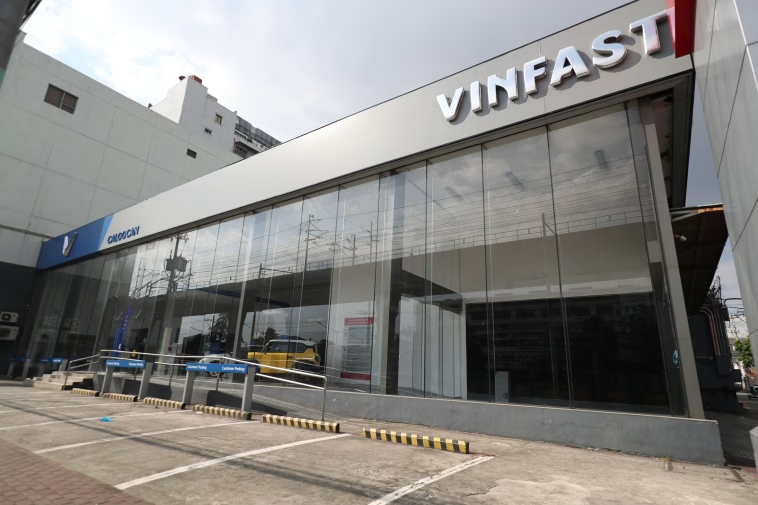
VinFast is turning its dealerships into mobility hubs in the Philippines, combining sales, financing, and rental options to help drivers navigate EV adoption amid fuel cost volatility.
On a humid afternoon in Caloocan, traffic hums steadily outside VinFast’s newest showroom, its glass facade reflecting a mix of jeepneys, motorcycles, and ride-hailing sedans inching forward. The site occupies a 1,506-square-meter property in Balintawak, a location long regarded as one of Metro Manila’s key transport gateways and a jump-off point to North Luzon.

Inside, the space feels modern and open, with the signature white and blue brand palette. VinFast displays its full local battery-electric lineup, from the compact VF 3 and VF 5 to the VF 6, VF 7, and the larger VF 9, giving visitors a clear sense of how each model fits different use cases. Rows of compact SUVs and transport-ready EVs are arranged with wide walking paths, chargers visible near the service bay, and a dedicated consultation corner where staff sit with customers over printed cost breakdowns.
This is VinFast’s 30th showroom in the Philippines. While newly opened, foot traffic suggests early momentum and reflects a deliberate strategy to place retail and service touchpoints in high-traffic corridors connecting Metro Manila with surrounding growth areas. The location draws not only urban buyers but also visitors from nearby provinces who are beginning to consider electric vehicles for daily transport. Families browse quietly. A driver in a ride-hailing uniform studies a dashboard display, tapping through range estimates.
It is early days, but the signals are clear. Interest is building, even as questions outnumber decisions. In a market still in its early stages, where charging infrastructure is expanding and familiarity with EV ownership remains limited, the dealership becomes a critical touchpoint. It is on the showroom floor, during test drives and direct conversations, that adoption begins to take shape. Buyers arrive with practical concerns, from how far a vehicle can go in Metro Manila traffic to how electricity costs compare with gasoline, questions that tie closely to daily routines and, for ride-hailing drivers, to income stability.
“Dealerships, which have traditionally been transactional in nature, need to evolve into hubs for education and support,” wrote a managing director at J.D. Power in the North American context, a view that remains highly relevant in the Philippines.[1]
With a customer-centric philosophy, VinFast, among other brands, has begun to respond to this shift by focusing on the showroom experience. Customers are guided through charging scenarios using local maps. Staff explain how overnight home charging compares with public fast charging. What was once a sales interaction increasingly resembles a consultation.
Last week, that role has expanded further. VinFast dealerships are becoming access points for multiple ways of using an EV, with the most recent addition being a rental model introduced through dealerships in Metro Manila, designed primarily for ride-hailing and transport service drivers.

Under this program, drivers can enter the EV market without purchasing a vehicle outright. Instead of a full down payment, the entry point is a low deposit, approximately a small percent of the vehicle value, for models such as the Herio Green and Limo Green, both developed specifically for commercial operations. This is followed by fixed daily rental rates starting from around PHP 1,000. The structure lowers the initial financial barrier and allows drivers to begin operating and earning immediately.
Operating costs are further stabilized through ecosystem support. Charging expenses are largely removed through VinFast’s charging partner V-Green network, with free charging incentives available until March 2029. For a driver covering 200 to 300 kilometers a day, a comparable gasoline vehicle can consume fuel worth around 24,000 to 36,000 pesos per month.
With a model such as the Herio Green, which is a version of the compact VinFast VF 5, operating under the same conditions, and charging costs effectively reduced to zero under current incentives, the monthly savings can reach tens of thousands of pesos. This number is particularly relevant in a market where fuel price swings can quickly erode driver’s daily earnings.
For buyers who prefer ownership, financing options remain available, structured to align repayment schedules with income patterns from transport services and support more manageable cash flow over time. By presenting ownership and rental paths side by side, the dealership helps customers weigh their options based on real financial conditions, shifting its role from a point of sale to a source of guidance.
“A shopper today needs a guide, think of it like an EV Sherpa, to help them with all the new realities of being an EV owner,” said JD Ney, J.D. Power’s Toronto-based Director of Canadian Automotive Practice.
That is the role dealerships, including those of brands like VinFast, can and should be expected to take on more actively as the country’s EV transition moves forward.





Backbiome is an advanced daily wellness supplement formulated to help support spinal comfort, reduce feelings of built-up tension, and promote freer, smoother movement throughout backbiome everyday life.