dotdailydose
The morning rush has begun. Patients fill waiting areas, nurses process admissions, doctors review charts, and administrative teams manage records for billing and compliance. In healthcare facilities across the Philippines, every minute counts, yet valuable time is still spent on paperwork.
From registration forms and laboratory results to prescriptions and patient records,

healthcare staff manage a constant stream of paperwork every single day. While these are essential to delivering quality care, manual processes can slow operations, lengthen patient wait times, and place additional pressure on already busy healthcare professionals.
As health facilities accelerate their digital transformation efforts, the challenge is no longer simply adopting technology but finding practical solutions that fit seamlessly into everyday clinical workflows.
With the Department of Health’s Philippine Digital Health Strategy and PhilHealth’s YAKAP primary care mandate requiring health facilities to centralize patient data into Electronic Medical Records (EMRs), digitizing paper-based records has become increasingly important. For hospitals and clinics, it is not only about regulatory compliance, but also about streamlining operations, improving efficiency, and supporting better patient care.
Empowering Nurses and Clinic Staff: Cutting Patient Queue Times from Minutes to Seconds
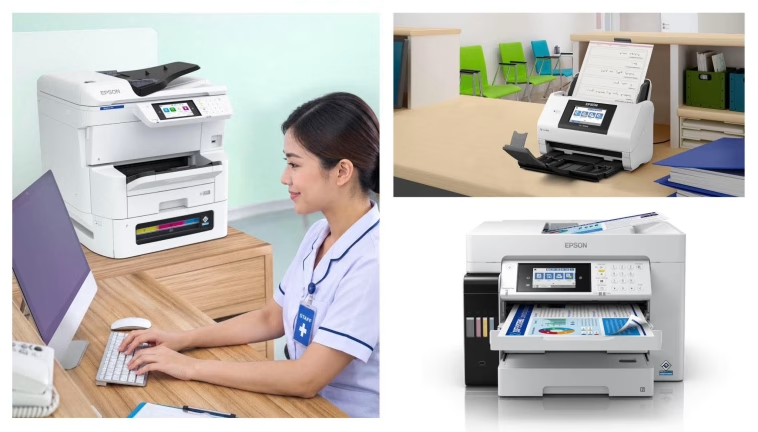
For nurses and front-desk staff, converting physical charts into digital EMR files can often feel like a time-consuming administrative bottleneck that slows down patient admissions. Specialized standalone scanners like the Epson WorkForce DS-790WN are designed to eliminate this friction, allowing healthcare workers to digitize patient records instantly right at the point of care.
Equipped with an intuitive 4.3-inch touchscreen and rapid scan speeds of up to 45 pages per minute, the DS-790WN lets nurses and triage staff scan patient charts, lab sheets, and ID cards directly to network folders or cloud databases with a single tap, without needing a dedicated computer terminal. By streamlining patient intake, clinics drastically reduce lobby overcrowding and patient waiting time. Furthermore, built-in security authentication ensures that sensitive patient records are transmitted safely, keeping facilities compliant with PhilHealth audit standards and data privacy laws.
Supporting Doctors: Smudge-Proof Prescriptions and Zero Pre-Print Costs
While digital databases store patient histories, doctors still depend on clear, physical documentation for prescriptions, medical certificates, diagnostic requests, and discharge summaries.
For doctors in private practice and community clinics, the Epson EcoTank L15160 provides an ultra-low-cost, high-yield printing solution capable of delivering up to 7,500 black pages per ink set. Using specialized water-resistant DURABrite pigment inks, prescriptions and medical forms remain sharp and smudge-free even when exposed to liquids, ensuring pharmacists always receive legible documentation. On-demand, high-quality color printing also means clinics no longer need to order costly pre-printed forms from external print shops or deal with expensive paper storage.

Helping Hospital Administrators: Lower Overhead, Medical-Grade Hygiene, and Grid Stability
For hospital administrators and facility managers overseeing multi-specialty wards, printing equipment must deliver speed, financial return on investment, and a safe working environment for medical staff.
Epson WorkForce Enterprise and WorkForce Pro business inkjet copiers utilize Heat-Free Technology, consuming up to 85 percent less electricity than traditional laser copiers. This lowers hospital utility bills and eliminates morning electrical load surges when doctors and nurses simultaneously output patient charts. Switching to business inkjet copiers also simplifies hospital inventory by replacing dozens of complicated laser toner cartridges with a single standardized ink set, while cutting replacement part waste by up to 59 percent.
Proven Reliability and Global Healthcare Results
This unified scanning and printing solution is already proven in demanding healthcare settings globally, such as Germany’s Diabetes Clinic Bad Mergentheim, where replacing laser copiers with business inkjet copiers eliminated external form printing costs, resolved facility power surges, and streamlined supply management for over 20,000 annual patients.
By combining high-speed EMR digitization with sustainable Heat-Free printing, Philippine healthcare institutions can achieve a future-proof, audit-ready operational framework that saves money, protects the environment, and improves the overall patient experience.
Partnering for Better Patient Care
“Technology in healthcare should serve the people providing the care—our doctors, nurses, healthcare staff, and hospital administrators,” said Noelle Gonzalez, Head of Marketing at Epson Philippines. “By pairing simple, one-touch scanning with clean, low-cost Heat-Free printing, we are helping healthcare teams across the Philippines meet national digital mandates effortlessly, lower operational overhead, and focus on their true priority, which is delivering exceptional care to every patient.”