dotdailydose
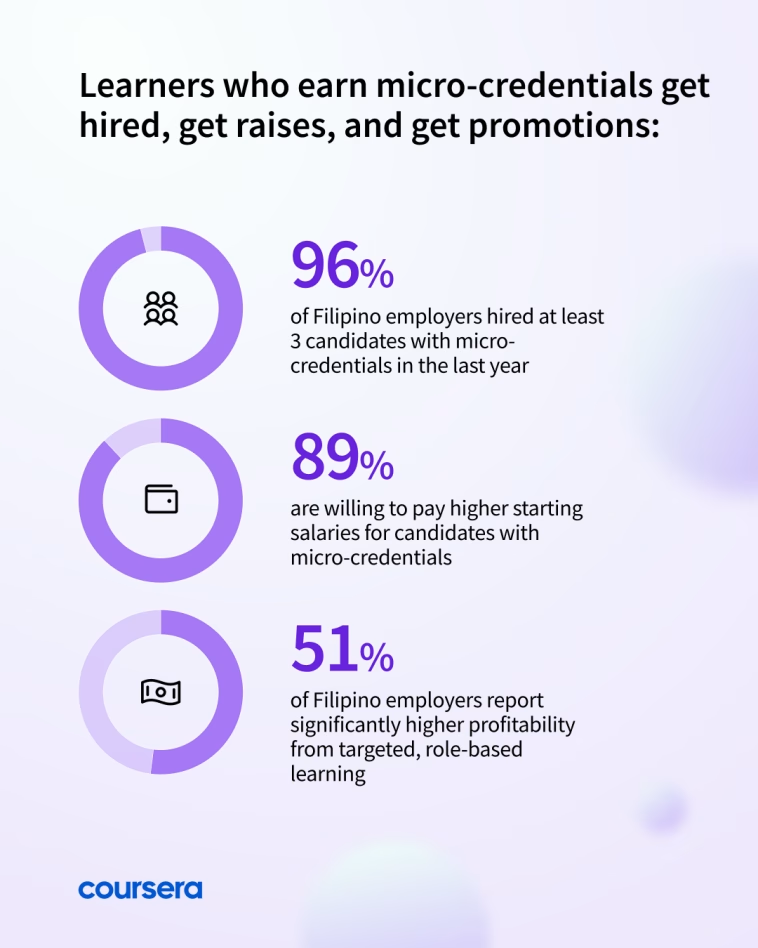
Micro-credentials are rapidly reshaping how Filipino employers hire, evaluate, and reward graduate talent, according to Coursera’s Micro-Credentials Impact Report 2026. The report finds that 96% of Filipino employers hired at least three candidates with micro-credentials in the past year, signaling a decisive shift toward skills-first hiring.
For employers, micro-credentials are becoming a trusted signal that candidates can contribute from day one. In fact, 77% of Filipino employers say candidates with micro-credentials move faster through hiring pipelines, four percentage points above the global average, reinforcing their growing value as a marker of job readiness.

A Google report estimates that AI could unlock approximately $50.7 billion in productivity and cost benefits for the Philippines by 2030 – an opportunity that hinges on a workforce equipped with the right skills. The Commission on Higher Education (CHED) has responded with a landmark policy – CMO No. 1, Series of 2025 – establishing a national framework for industry-aligned, stackable micro-credentials, placing higher education at the center of that skills transformation.
Based on insights from more than 3,500 employers, learners, and higher education leaders across seven countries including the Philippines, the 2026 report finds that 89% of Filipino employers are willing to offer higher starting salaries to graduates with micro-credentials, with 36% willing to offer more than a 15% increase for GenAI micro-credentials. 85% of Filipino graduates who earned micro-credentials secured a role aligned to their field within 12 months.
“As AI reshapes the workplace, employers are placing a premium on candidates who can prove they have practical, job-ready skills. In the Philippines, micro-credentials are no longer just a differentiator – they are becoming an essential signal of employability,” said Ashutosh Gupta, Managing Director, Asia Pacific, Coursera. “The data shows strong alignment between employers, students, and higher education leaders: learners want credentials that count toward degrees, employers are willing to pay more for them, and universities see them as critical to staying relevant. CHED’s CMO is a pivotal step, giving universities the policy foundation to embed micro-credentials at scale. Those that move fast will define the next generation of Filipino talent.”
Key findings for the Philippines:

Employers are embracing micro-credentials as proof of job readiness:
- 96% of Filipino employers hired at least 3 candidates with micro-credentials in the last year
- 89% are willing to offer higher starting salaries to graduates with micro-credentials
- 90% say entry-level hires with micro-credentials perform better in their first year
- 77% say credentialed candidates move faster through hiring pipelines
Students are choosing institutions that offer credit-integrated credentials:
- 6x as many Filipino students are likely to pursue micro-credentials with formal credit recognition (79%) vs without (17%)
- 62% say the strongest signal of rigor is an industry-created micro-credential that counts toward a degree
- 85% of Filipino graduates secured a role aligned to their field within 12 months
Higher education leaders see embedded micro-credentials as a competitive advantage:
- 86% agree that embedding micro-credentials links academic learning with workforce relevance
- 63% say institutions without embedded micro-credentials face moderate or significant strategic risk
- 75% say programs with embedded micro-credentials experience higher student retention
- 75% agree that embedding micro-credentials leads to a faster curriculum refresh rate
iPeople Inc. is among the institutions already leading the charge, having embedded 50+ Professional Certificates across six schools which include all the Mapua schools in Manila, Laguna, Mindanao; National Teachers College, University of Nueva Caceres as well as the modern Mapua Malayan Digital College. “The Philippines is at an inflection point. Our graduates are talented, but talent alone doesn’t win in a global job market – proof of skills does. Micro-credentials embedded into a degree give Filipino students exactly that: industry-recognised, globally credible evidence of what they can deliver from day one. What gives me real confidence is that CHED is now establishing policy frameworks around this. Through our partnership with Coursera, we’re able to bring these credentials into our programs at scale, combining global content with local academic rigor,” said Dr. Dodjie Maestrecampo, President & CEO, Mapua Education Group.
To download the full report and explore key findings, click here.