dotdailydose
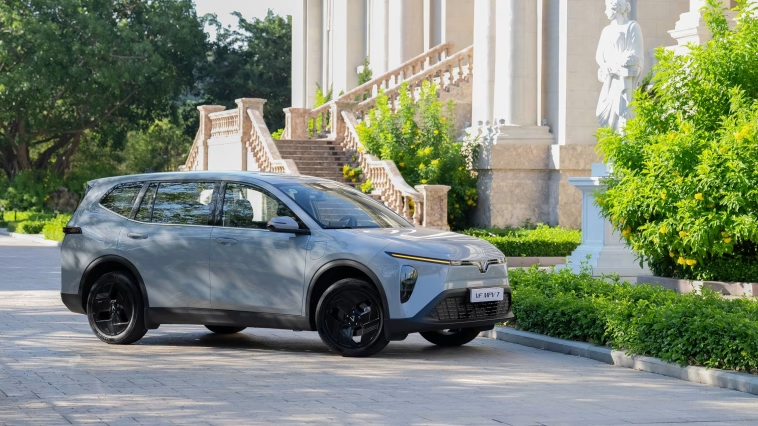
Can an electric vehicle handle the rainy season? The VinFast VF MPV 7 packs several features designed to help Filipino drivers navigate the rainy season with greater confidence.
When the rainy season arrives in the Philippines, it often brings more than just a little inconvenience. Sudden downpours, flooded roads, reduced visibility, and traffic congestion become part of daily life for many motorists. It’s also the time of year when misconceptions about electric vehicles tend to resurface.

Can EVs handle floods? Are they safe in heavy rain? Will charging become a problem during bad weather?
The reality is that modern EVs are engineered to operate in challenging weather conditions, often with many of the same safety and convenience features found in conventional vehicles. The recently launched VinFast VF MPV 7 is one example. Beyond its spacious seven-seat layout and family-friendly practicality, it comes equipped with several features that can make rainy-season driving easier and more comfortable.
Defogger: Small Feature, Big Difference
One of the most underrated features during the rainy season is perhaps the rear window defogger.
Anyone who has spent time stuck in traffic during a downpour knows how quickly windows can fog up, especially when the air-conditioning is running and the cabin is filled with passengers. The VF MPV 7 comes equipped with a rear defogger that helps clear condensation from the rear glass. It may not be the flashiest feature on the spec sheet, but when visibility drops, every extra bit of visibility matters.
Other useful features in this category are the rear wiper and rear-view camera, which help drivers maintain visibility when reversing or maneuvering in tight parking spaces during bad weather, as heavy rain can quickly coat the rear glass with water and road grime.
Anyone who has tried backing out of a crowded mall parking lot during a rainstorm will understand the value of these features.
Ground Clearance & Water-Wading Depth: Non-Negotiable
One of the most important specifications to consider during the rainy season, perhaps even a non-negotiable one, is ground clearance.
The VF MPV 7 offers 185 mm of ground clearance, comfortably above the 160 mm threshold that many seasoned automotive observers consider desirable for Philippine driving conditions. This can help drivers deal with uneven roads, standing water, and flooded intersections that commonly appear during storms.
What’s more, the VF MPV 7 is rated with a water-wading depth of 300 mm, providing an additional layer of reassurance when encountering flooded streets.
Taken together, these two factors help dispel the common myth that EVs are somehow more vulnerable to water than gasoline-powered vehicles. In reality, modern electric vehicles undergo extensive testing for water resistance.
However, one important point to remember is that these figures should not be confused with flood-driving capability. Whether a vehicle is powered by gasoline, diesel, hybrid, or electricity, manufacturers generally advise drivers to avoid crossing flooded roads whenever a safer alternative route is available. Features such as ground clearance, water-wading capability, and electronic safety systems are designed to provide additional protection in unexpected situations, not to encourage drivers to take unnecessary risks.
Stability Control and Traction Control: The Silent Safety Partners
Rain reduces tire grip. That’s simply physics.
When roads become slippery, electronic safety systems become increasingly important. The VF MPV 7 comes equipped with Electronic Stability Control (ESC), Traction Control System (TCS), Anti-lock Braking System (ABS), Electronic Brakeforce Distribution (EBD), and Hill Start Assist.

Most drivers will rarely notice these systems working, which is exactly how they’re designed.
If a wheel begins to lose traction on a wet surface, these systems can automatically adjust power delivery and braking force to help maintain control. Think of them as an invisible safety net that steps in when road conditions become less predictable.
Safe Charging in the Rain
Many first-time EV buyers assume charging an electric vehicle in wet weather could be unsafe. This may stem from what many of us learned as children: that water and electricity are a bad combination.
In reality, EV charging systems are designed specifically to operate outdoors and in varying weather conditions. Charging stations and vehicles incorporate multiple layers of protection that automatically monitor and manage electrical safety.
The VF MPV 7 can recharge from 10% to 70% in around 30 minutes using DC fast charging. For many families, this means charging can easily fit into a coffee stop, meal break, or rest stop during a road trip.
Rather than being a limitation during the rainy season, charging often becomes just another routine part of vehicle ownership.
“Always-On” Lower Operating Costs
Traffic congestion often worsens when storms arrive, which can significantly increase fuel consumption in conventional vehicles. Electric vehicles, however, are far less affected by stop-and-go traffic because they do not idle in the traditional sense.
Even better, VinFast’s free charging program runs through March 2029, equivalent to nearly three years of charging savings from today. A family driving around 1,500 kilometers per month could potentially save hundreds of thousands of pesos in energy costs compared with gasoline-powered MPVs in the same segment over that period, depending on fuel and electricity prices.
For buyers considering their first EV, VinFast has also introduced ownership options designed to make the transition easier. The VF MPV 7 starts at ₱1,239,000 under the battery subscription model, reducing the upfront purchase price and making the vehicle more accessible to families entering the EV world for the first time.
Early adopters receive additional benefits as well. The first 1,000 customers who choose the battery subscription option will receive one year of free battery subscription for up to 2,000 kilometers per month. Meanwhile, customers who choose to purchase the vehicle with the battery included will receive a direct discount of ₱27,200.
These programs address another common misconception about EVs: that switching to electric necessarily requires a large upfront investment. By offering both battery subscription and battery-included options, buyers can choose the ownership model that best fits their budget and driving habits.
The Bottom Line
The rainy season is often when motorists appreciate their vehicles the most. Comfort, visibility, safety, and confidence become far more important than acceleration figures or styling details.
The VinFast VF MPV 7 may not have every feature found on a hardcore off-road SUV, but it does offer many of the technologies that matter most during wet-weather driving. From its rear defogger to its 185 mm ground clearance, 300 mm water-wading capability, and comprehensive electronic safety suite, it demonstrates that modern EVs are designed with real-world conditions in mind.