
 dotdailydose
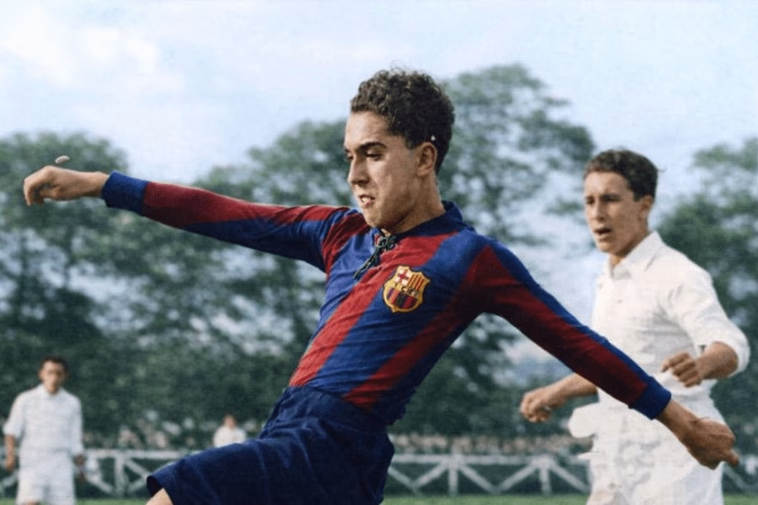
Before Philippine football had the global attention it seeks today, a Filipino from Iloilo had already shown the world what was possible.
His name was Paulino Alcántara.

Born in October 7, 1896, Alcántara rose from the Philippines to become one of the earliest great stars of FC Barcelona. His journey, from a teenage footballer to an international sporting figure, from representing the Philippines to building a career in medicine, is more than a remarkable chapter in football history.
It is a reminder that the Filipino story has always included the capacity to achieve greatness on the world stage.
A Filipino who made history
Alcántara was only 15 when he made his debut for Barcelona in 1912.
He announced himself with a hat-trick. He would go on to score 395 goals in 399 matches for the club, a record that stood for decades before it was eventually surpassed by Lionel Messi in 2014. For a Filipino to have reached such heights in an era when international opportunities were far more limited is extraordinary.
But perhaps what makes Alcántara’s story most powerful today is not simply the records he left behind. It is what his journey represents. Filipino football greatness is not without precedent. It has roots. It has history. It has provenance.
And Alcántara is one of the strongest examples of that history.
Greatness that crossed borders
Alcántara’s journey was never confined to one country.
He returned to the Philippines to pursue medicine, stepping away from football to continue his studies. But Barcelona called him back, and in 1918 he returned to the club. His story reflects a generation of Filipinos who moved between worlds, carrying their identity and ambition with them.
On the football pitch, Alcántara proved that where a player comes from does not have to define how far that player can go. His success in Barcelona became part of Filipino sporting history, and a source of possibility for generations who came after him.
He also played for the Philippines
Alcántara’s connection to the country was not simply one of heritage. In 1917, he represented the Philippines at the Far Eastern Championship Games in Tokyo. The Philippines won silver, with Alcántara scoring twice in the team’s historic 15–2 victory over Japan. In that moment, the Filipino name was not only present on an international football field. It was making an impact.

More than a century later, that story still matters because it challenges the idea that Philippine football greatness is something the country is only beginning to discover. We have been here before.
A legacy that can inspire what comes next
Alcántara eventually retired from football in 1927 to pursue medicine, but his influence continued long after his playing days. His legacy has been recognized in both Spain and the Philippines, including through the Philippine Sports Hall of Fame and the Copa Paulino Alcántara. But perhaps his greatest legacy is less tangible. It is the possibility his story represents.
For today’s Filipino footballers, Alcántara is proof that greatness can come from the Philippines. For young players watching the national team today, his story offers something even more important – hope.
Hope that Filipino players can compete. Hope that Filipino football can belong on bigger stages. And hope that the next extraordinary chapter may already be taking shape among the players growing up in the Philippines today.
From provenance to possibility
Philippine football has evolved significantly since Alcántara’s time. The game is different. The pathways are different. The players are different. But the ambition remains.
Today’s national team is not starting from nothing. It is building on a history that includes Filipinos who dared to compete, represent their country and make their mark beyond its shores. Alcántara gives that history a face. He gives the next generation a reference point. And, perhaps most importantly, he gives Filipino football something to believe in. Because greatness is not foreign to the Filipino football story. It is already part of it.
The challenge now is not to recreate Alcántara’s story, but to create the next one.
More than a name – a story to carry forward
A national team identity is more than a name. It is the history behind it. The players who carry it. The supporters who believe in it. And the generations who see themselves in it.
Paulino Alcántara’s story began with a Filipino teenager who stepped onto a football field more than a century ago and went on to make history halfway around the world. His story remains a reminder of what Filipino football can become when talent is matched with ambition, courage and belief.
The name may belong to one generation. The legacy belongs to all who come after it. And perhaps somewhere today, another young Filipino is waiting for the moment to prove that the next great football story can come from here, too.




