
 dotdailydose
Persistence, resilience, and adaptability, among others, are often touted as the most common traits successful entrepreneurs have. They’re not afraid to fail or take risks; they continuously learn, whether from their mistakes or from others. They won’t let a setback stop them from bringing their vision to life. They can stand strong against or ride the wave of disruption. Their innovative thinking can address a critical void within the industry.
It is why after nearly 100 years, Far Eastern University (FEU) has strengthened further the mold that produced successful professionals in the business industry and public sector. According to Dr. Maria Carmen B. Lapuz, Dean of the Institute of Accounts, Business, and Finance (IABF), the institute has found more value in experiential education, integrating it in every undergraduate program in the institute and allowing the institute to evolve and adapt with the times. “After all, as paradigms shift and businesses change, so shall we,” said IABF Dean Lapuz.

Education with practical, real-world applications
By implementing an experiential approach, IABF has eschewed focusing on traditional business models and maximizing shareholder value, purely theoretical and lecture-heavy instruction, and emphasizing memorization of procedures and techniques, among other outdated teaching techniques. Notably, its entire faculty is composed of professors with deep industry experience, which they integrate in the lessons. IABF Dean Lapuz said, “We want to focus more on immersive learning experiences that have real-world applications to make sure students are well prepared.”
IABF’s Bachelor of Science in Accountancy (BSA) program is one of the oldest programs of the university, even predating the university itself. This internationally recognized and accredited program uses case-based and problem-based learning techniques, imparting rigor and ethical clarity. It also maintains strong partnerships with leading accounting firms to co-develop and continuously enhance its curriculum and the delivery of instruction, ensuring alignment with industry standards and evolving professional practice. This allows students to apply accounting techniques and concepts at a practical level akin to what they can expect in the real world.
The school has consistently produced CPA Licensure Exam passers and topnotchers over the years.
On the other hand, its BS Business Administration (BSBA) program uses both experiential learning and a collaborative approach to learning shaped by employer feedback and industry demands, helping ensure graduates develop not only technical knowledge but also critical business acumen. Live cases used by the program were codeveloped with FEU’s industry partners to help ensure the concepts they learn are fresh and practical.
As of 2024, this program has three specialized tracks, namely Financial Management, Marketing Management, and Entrepreneurial Management.

BS Internal Auditing (BSIA) is another internationally recognized and accredited program of the IABF. Like BSBA, this program was built with collaboration and industry needs in mind. Aligned with global internal auditing standards, it prepares students for risk-based auditing, IT audit, and advisory roles. Its case-based learning approach uses cases codeveloped with FEU’s industry partners and the Philippine chapter of the Institute of Internal Auditors.
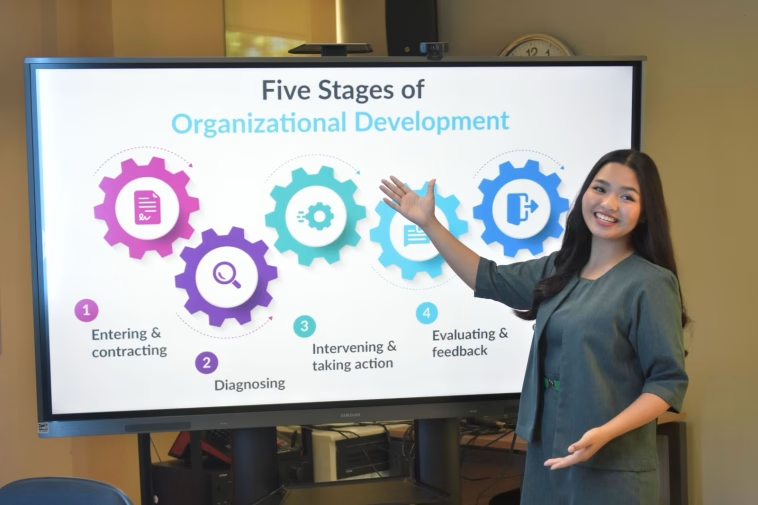
The newer BS Human Resources and Organizational Development (BSHROD) and BS Business Economics (BSBE) are originally specialized tracks of the BSBA program and were established in 2024. Both programs have data analytics projects and debate and policy advocacy, with BSHROD being more focused on organizational agility, workforce planning, and values-driven leadership and BSBE being more focused on integration of analytics and sustainability in the industry.
BSHROD and BSBE are expected to have its first batch of graduates (as a separate program from BSBA) in FEU’s 100th year.
An enduring legacy of change and success
FEU IABF has spent nearly a century shaping future business leaders, building a legacy reflected across generations of industry influence and leadership. Among its distinguished alumni are pioneering figures such as Henry Sy Sr., founder of SM, Benjamin Punongbayan, founder of P&A Grant Thornton, and Alfonso Yuchengco, founder of the Yuchengco Group of Companies, whose contributions helped shape key sectors of the Philippine economy.
This tradition of excellence continues in more recent graduates, including Megaworld President and CEO Lourdes Gutierrez-Alfonso, Deloitte Sweden Senior Manager Febb Diola, and Common Ground Country Manager Roegan Taron, among many others who continue to lead across global and local industries.
The university’s commitment to applied excellence, ethical formation, and industry relevance produced not only competent, business-minded professionals but also community-engaged, service-oriented individuals that are ready to lead in dynamic environments. “We want the IABF’s programs to be firmly rooted in the university’s values of Fortitude, Excellence, and Uprightness,” said IABF Dean Lapuz. “This enables our students to apply concepts into practice, make datadriven decisions, adapt to circumstances, and become business leaders who shape the future.”





Backbiome is an advanced daily wellness supplement formulated to help support spinal comfort, reduce feelings of built-up tension, and promote freer, smoother movement throughout backbiome everyday life.